
AEO & GEO Optimization Services for AI Search Visibility
Unlock the power of AI-driven SEO services to attract more qualified leads, boost conversions, and grow your business efficiently.

What Is AEO? (Answer Engine Optimization)
AEO stands for Answer Engine Optimization. It is the process of writing and structuring your website content so that AI-powered tools can find your answer and display it directly to users, often without them ever needing to click on your website.
Traditional search engines show a list of links. Answer Engine Optimization Services go one step further: they extract the single best answer from a website and present it directly on the results page, in a Featured Snippet, a Voice Search response, a People Also Ask box, or an AI-generated summary.

Which tools use AEO?
- Google Featured Snippets and People Also Ask boxes
- Google AI Overviews (Search Generative Experience)
- Siri and Apple Search
- Alexa (Amazon)
- Bing Copilot
- Perplexity AI
- ChatGPT (when browsing the web)
What Is GEO? (Generative Engine Optimization)
GEO stands for Generative Engine Optimization. It is the practice of making your content trustworthy and well-structured enough that large AI language models like ChatGPT, Google Gemini, and Bing Copilot actually recommend or cite your business when users have a conversation with them.
When someone asks ChatGPT, “What are the best digital marketing agencies in Houston?” the answer it generates comes from content it has read and indexed across the web. Generative Engine Optimization Services is the practice of ensuring your business is part of the answer.
How is GEO different from AEO?
| AEO | GEO |
|---|---|
| Optimises for direct answer boxes on search results pages | Optimises for AI chatbot and assistant recommendations |
| Works on Google Featured Snippets, voice assistants | Works on ChatGPT, Gemini, Copilot, Perplexity |
AEO vs GEO — Key Differences
| Feature | AEO | GEO |
|---|---|---|
| Goal | Become the featured answer | Get cited by AI chat tools |
| Where results appear | Snippets, PAA, voice assistants | ChatGPT, Gemini, Copilot |
| Key technique | Q&A structure, schema markup, concise answers | Topical authority, citable content |
| Cost per click | Free — zero cost per appearance | Free — zero cost per mention |
| Time to results | 45–90 days for first wins | 3–6 months for consistent citations |
| Competition (2025) | Medium — still an opportunity | Low — most businesses have not started |
How AEO & GEO Works — Step by Step
Here is exactly what goes into making your website content readable, citable, and recommendable by AI-powered search tools.
Identify the Questions People Are Asking
The foundation is research. We find the exact questions your potential customers type into Google or ask AI tools — such as “best plumber Houston TX” or “how much does commercial HVAC cost?” These become the basis for every page we optimise.
Write Direct, Specific Answers
Each question gets a concise, authoritative answer — typically 40 to 80 words. AI tools strongly prefer clear, confident answers over vague or promotional language. We rewrite existing pages or create new content built around these questions.
Add Structured Data (Schema Markup)
Schema markup is invisible code added to your website that tells Google, Bing, and AI tools exactly what type of content each section contains — FAQ, HowTo, Product, LocalBusiness, and so on. This is what allows AI tools to reliably extract and display your content.
Build Topical Authority
AI systems favour sources that cover a topic in depth, not just mention it once. We create a cluster of related content — blog posts, FAQs, service pages, guides — that signals you are the recognised expert in your field and your location.
Optimise for Local and Conversational Queries
Most voice searches and AI queries are conversational and local: “Who is the best dentist near me in Katy?” We tailor your content to match the natural way people ask questions about your services and your city.
Track Appearances and Refine
We monitor whether your content appears in Featured Snippets, People Also Ask boxes, Google AI Overviews, Bing Copilot, and ChatGPT responses. That data drives continuous improvement and expansion of your AI visibility.
Case Studies — Real Business Results
Four examples showing the challenge, the AEO/GEO approach, and the measurable outcome.
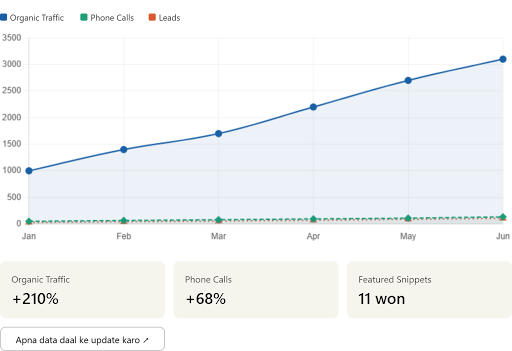
Case Study 1: HVAC & Plumbing Company — Houston, Texas
Industry: Local Services
| Challenge | The company ranked on page 2 for most keywords and received almost zero traffic from voice or AI search. Competitors appeared in Google's Featured Snippets for every high-value service query. |
| Solution | 18 service pages were rewritten in Q&A format with direct, concise answers. FAQPage and LocalBusiness schema was added. A 12-article content cluster on HVAC topics specific to Houston's climate was created. |
| How AEO Helped | Google began extracting answers from their FAQ sections into the Featured Snippet position. The business also started appearing in Bing Copilot responses for queries like "best HVAC Houston." |
| Result |
✓ Organic traffic up 210% ✓ 11 featured snippets won ✓ Phone calls up 68% within 90 days |
Case Study 2: B2B Software Company — National (USA)
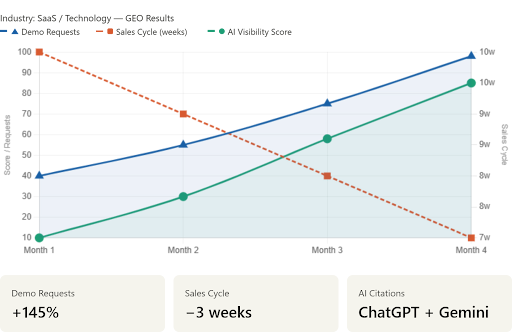
Industry: SaaS / Technology
- Cited in ChatGPT and Google Gemini
- Demo requests up 145%
- Average sales cycle shortened by 3 weeks
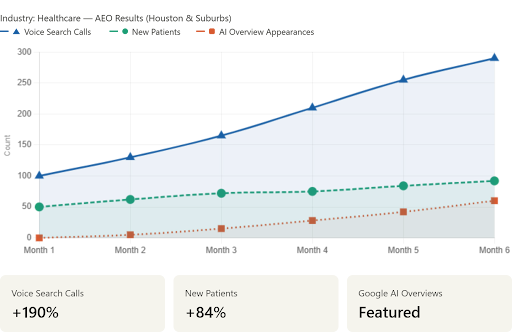
Case Study 3: Multi-Location Dental Practice — Houston & Suburbs
Industry: Healthcare
- Cited in ChatGPT and Google Gemini
- Demo requests up 145%
- Average sales cycle shortened by 3 weeks
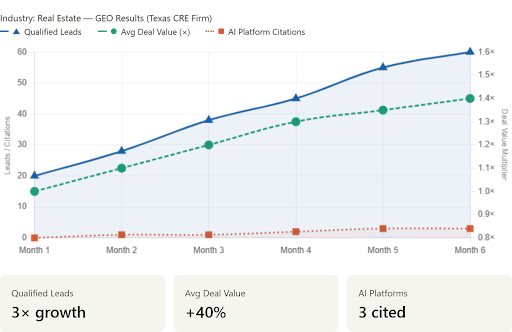
Case Study 4: Commercial Real Estate Firm — Texas
Industry: Real Estate
- Cited across 3 AI platforms
- Qualified leads up 3x
- Average deal value increased 40%
Ready to Make Your Business the Answer AI Tools Recommend?
Book a Free Consultation · Call (281) 570-5804 · websiteleadsagency.com
Frequently Asked Questions (FAQ)
What is Answer Engine Optimization (AEO)?
AEO is the process of structuring your website content so that AI Search Optimization Services, Google’s Featured Snippets, People Also Ask, Siri, Alexa, and chatbots — can find your answer and display it directly to users. The goal is to be the source an AI tool reads out or quotes when someone asks a relevant question.
What is Generative Engine Optimization (GEO)
GEO is the practice of making your content trustworthy and well-structured enough that large language models — ChatGPT, Google Gemini, Bing Copilot — actually recommend or cite your business in their conversational AI responses. It is about becoming a trusted source that AI systems pull from when users ask questions related to your industry.
How long does it take to see results?
Most businesses begin seeing AEO results — featured snippets, People Also Ask appearances, voice search pickups — within 45 to 90 days. GEO results from LLM tools like ChatGPT typically build over 3 to 6 months as AI models index and incorporate updated web content into their responses.
Do I need a large budget to implement AEO or GEO?
No. AEO and GEO are primarily content and structure strategies, not paid advertising. You do not pay Google or AI platforms to appear in their answers — you earn that position through well-structured content and credibility. The investment is in strategy and content work, not in ongoing media spend, making it one of the most cost-effective long-term marketing channels available.
Can any business benefit from AEO and GEO?
Yes. Any business that relies on customers finding them online can benefit — from local service businesses in Houston to national B2B companies. The strategies are adapted to your industry, your audience, and the questions your specific customers ask.